Homemade Apple Cider Vinegar
Starting from Fresh Apple Juice
"Step by step procedure
for making apple cider vinegar."
Homemade apple cider vinegar made the traditional way, starting from apple juice, is a two-step process. Both steps are easy to do and the process is completly natural.
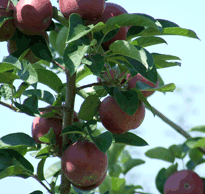 First, the freshly pressed apple juice is fermented into hard apple cider using the natural yeasts already present in the juice. The only equipment you will need is an air lock for the fermentation and a hydrometer to determine the potential alcohol content of the finished cider (both are inexpensive and readily available at your local home brew shop).
Once completed, the hard apple cider is then simply exposed to air to convert it into homemade apple cider vinegar as outlined in the Vinegar Making Procedure.
Procedure for Making
Traditional Hard Apple Cider
Used to get homemade apple cider vinegar
1) Use one gallon (3.8 Liters) of freshly pressed apple juice from your local apple orchard. The juice should be unfiltered, additive free, and non-pasteurized for maximum nutrition and flavor and to allow the natural yeasts in the juice to ferment the sugar to alcohol.
2) Determine the amount of sugar in the apple juice by measuring its specific gravity or density with a simple hydrometer. The more sugar contained in the apple juice, the higher its density.
(Click here for information on a hydrometer and how to use it to determine sugar content.)
Juice made from North American dessert apples will have a specific gravity between 1.040 and 1.050 and if allowed to ferment fully, will result in a hard cider with around 5.5 to 6.5 percent alcohol content.
If, on the off chance you find the apple juice specific gravity less than 1.040, then add some plain old granulated white sugar (sucrose) directly to the juice as follows:
Add 2.25 ounces (67.5 grams) of sugar to raise the specific gravity of one gallon of juice by 5 points (for example from 1.035 to 1.040).
3) Unscrew the top of the one gallon juice container, screw on a 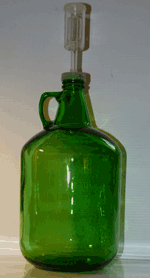 fermentation air lock, and allow the container to stand at room temperature for 6 to 8 weeks. The air lock will allow the carbon dioxide gas, produced during the fermentation, to escape while at the same time preventing the oxygen in the air from getting into the cider and interfering with the reaction.
(This hard apple cider and homemade apple cider vinegar fermentation equipment can be purchased online at Amazon.com)
4) After 6 to 8 weeks the fermentation will be complete. There will be no more carbon dioxide gas escaping through the air lock and there will be a thick deposit of lees at the bottom of the container.
To make sure all the sugar has been converted to alcohol, check the cider's specific gravity, which should be less than 1.005.
If the reading is still too high, wait another week and test again.
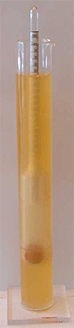
(Click here for information on a hydrometer and how to use it to determine potential alcohol content.)
To compute the alcohol content of the completed apple cider, take a hydrometer reading (using the potential alcohol scale) after fermentation and subtract it from the value you obtained before fermentation.
You are now ready to make your own homemade apple cider vinegar, just follow the procedure outlined in the Vinegar Making Procedure Starting from Hard Apple Cider.
Recent Articles


-
Types of vinegar
June 15, 2022

New developments in apple cider vinegar supplements and gummies have been highlighted.
Bragg has developed a new ACV capsule that has the same amount of acetic acid as one teaspoon of liquid apple cider vinegar and... -
Intestinal parasites treated with apple cider vinegar.
Dec 07, 2021
(Comments by Roger- translated from French) I have 3 cats that go outside and need to be dewormed every 3 months with Drontal tablets.
But I too had the feeling that...
-
Apple cider vinegar recipe for congestion.
April 19, 2021
My mother used to make us a drink containing ACV that she gave us when we were congested, it didn't taste good but it worked.
Does anybody remember...
-
Vinegar and Blood Sugar Levels.
June 28, 2020
Yes my blood sugar goes as high as 170, but mostly it's 140-148.
But now that I'm drinking vinegar water, its been staying at...
-
Apple Cider Vinegar Gummies.
Mar 10, 2020
This is one of the newest ways of adding apple cider vinegar to a popular product.
Convenience and taste are the driving factors here, after all, who doesn't like the taste and portability of gummy candies?
The leading manufactures of ACV gummies, though, are… -
Thanks to Cider Vinegar, my Mare has no more gas nor Colic problems.
Dec 26, 2019
(Translated from French) I am a naturalist. My horses are fed with hay for the elderly because they are 27 and 28 year old seniors, and soaked pellets...
-
Two minute cure for painful hand cramps using apple cider vinegar
September 7, 2019
After being told to drink more water, take vitamins, stretch and massage my hand, nothing worked to relieve my painful hand cramps and sometimes leg cramps.
But I recently tried apple cider vinegar, honey and water.
In about two minutes …